Featured snippet answer
A water ionizer filters tap water and uses electrolysis to split it into alkaline drinking water, pH 8 to 10, and acidic water for cleaning. In the UK a unit typically costs around £950 to £2,650. It is worth it only if you use it for years and stop buying bottled water, because the health benefits are not settled.
The short answer
A water ionizer does change your water. It filters it and it raises its pH. What it does not do, on the current evidence, is change your body. Your blood pH stays between 7.35 and 7.45 no matter what you drink, and your stomach acid neutralises alkaline water before it reaches your bloodstream. So the question is not whether the machine works, but whether filtered, higher pH water is worth £1,000 or more to you. For most people the honest answer is that a good filter gives you most of the benefit for far less money. This guide explains how ionizers work, what they cost in the UK, what the research actually says, and who should and should not buy one.
What is a water ionizer?
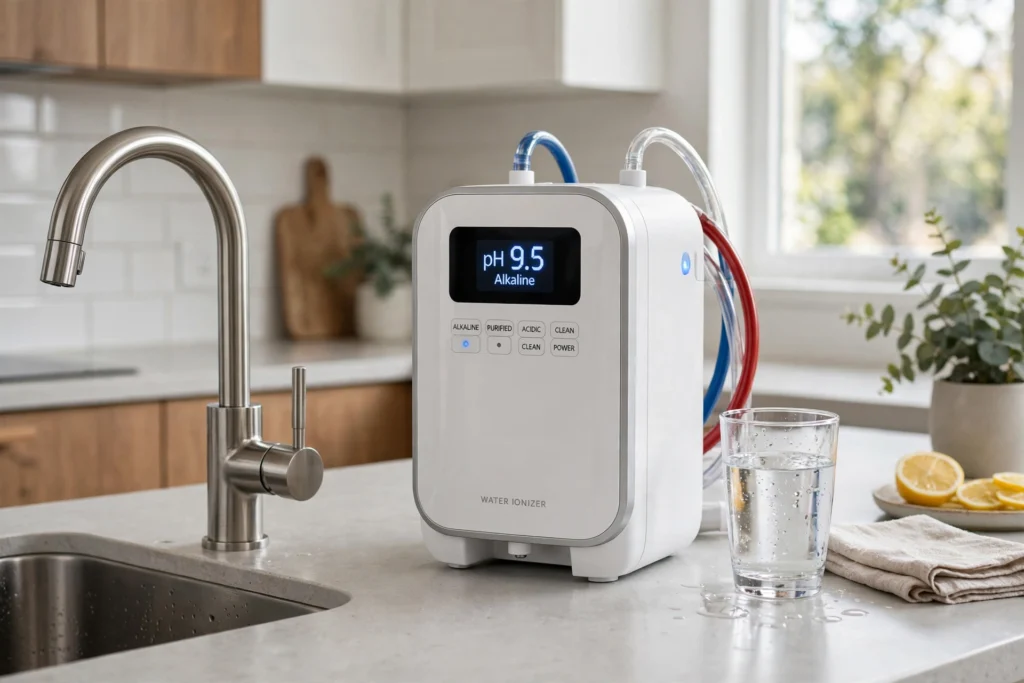
A water ionizer, also called an alkaline water machine, is a box that sits on your kitchen worktop, connects to your tap and to a power socket, and turns ordinary tap water into two streams. One stream is alkaline water for drinking. The other is acidic water, which is not for drinking and is usually used for cleaning or on skin.
The process has two stages. First, the tap water passes through a filter, usually activated carbon, which removes chlorine, sediment and some other contaminants. Second, the filtered water flows into an electrolysis chamber. Inside the chamber are plates, usually platinum-coated titanium, and a low voltage direct current passes across them. The current separates the minerals in the water. Alkaline minerals such as calcium and magnesium go to one side and form the drinking stream, while acidic minerals go to the other side and form the acidic stream. The number of plates matters: more plates generally mean a wider pH range and a stronger effect, which is why premium models advertise 7, 9 or 13 plates.
Many ionizers also claim a negative ORP figure, which stands for oxidation reduction potential and is presented as antioxidant potential. Some also produce dissolved molecular hydrogen. Both are seller claims about the water’s chemistry, and neither is a proven health benefit on its own.
What does a water ionizer actually do to your water?
Three things change, and it helps to keep them separate, because only some of them matter.
First, the water is filtered. The carbon filter stage removes chlorine and sediment, which can improve the taste and smell of tap water. This is the most useful thing an ionizer does, and it is also the thing a far cheaper filter does just as well.
Second, the pH rises. The drinking stream usually comes out at pH 8 to 10, depending on the machine and the mineral content of your tap water. The acidic stream comes out lower, and is meant for cleaning. The pH change is real and measurable, and it is what the machine is sold on.
Third, the water gains dissolved hydrogen and a negative ORP reading. Sellers present this as the antioxidant part of the product. The chemistry is real, but whether it does anything for your health is a separate question, and the evidence for it is thin.
How much does a water ionizer cost in the UK?
A proper countertop ionizer in the UK typically costs around £950 to £2,650. That range comes from current UK listings: the Aqualine R-Series Prime is listed at £949.99 to £2,599.99, the Alkaline Prime 901S with 9 plates is listed at £1,596, the Alkaline Prime 1301S with 13 plates is listed at £2,146, the Aqua Ionizer Deluxe 5.0 is listed at £1,132.02, and the Aqua Ionizer Deluxe 9.0 is listed at £2,636.47. Cheaper hydrogen jugs and bottles exist from around £70 to £110, but those are a different product: a small hydrogen generator, not a full ionizer with filtration and pH control.
The upfront price is not the whole cost. Filters need replacing, typically every 6 to 12 months depending on the model and your water, and replacement filters cost money. The unit also uses electricity while it runs. A worked example makes the maths clear: a £1,600 unit kept for five years works out at £320 a year before filters and electricity. That is an example, not a market figure, and your own total depends on the model you buy and how long you keep it. Compare that with bottled water, which costs around 60 pence a litre or more in the shops, and the case for an ionizer rests entirely on how much bottled water it replaces and how many years you keep the machine.
| Option | What it does | Changes pH? | Typical UK cost | Best for |
|---|---|---|---|---|
| Water ionizer | Filters water, then splits it into alkaline and acidic streams | Yes, drinking stream usually pH 8 to 10 | Around £950 to £2,650 | People who want filtered water plus pH control and will keep the unit for years |
| Filter jug | Carbon filtration, removes chlorine and some sediment | No, or minimal | Low upfront cost, plus regular filter cartridges | Improving the taste of tap water cheaply |
| Reverse osmosis system | Pushes water through a membrane that removes a wide range of contaminants | No, or minimal | Mid range, plus filter and membrane changes | Heavily contaminated water, such as lead or arsenic concerns |
| Bottled alkaline water | Ready made alkaline water, no machine needed | Yes, already alkaline | Around 60 pence a litre or more | Trying alkaline water before buying a machine |
Is alkaline water good for you? What the evidence says
This is where honest reporting matters, because the marketing runs far ahead of the research. The health benefits of alkaline water are not settled, and the strongest evidence we have is narrow.
Start with the basic physiology. Your blood pH is held in a tight range, about 7.35 to 7.45, by your lungs and kidneys, and it stays there no matter what you drink. Your stomach acid sits at about pH 1.5 to 3.5, and it neutralises alkaline water almost as soon as you drink it. There is no plausible way for a glass of pH 9 water to change your body’s internal chemistry in any lasting way.
The most thorough review of the subject is a systematic review published in BMJ Open in 2016 by Fenton and Huang. They searched more than 8,000 citations for research on dietary acid load or alkaline water and cancer. Only one study met their criteria, and it found no link between dietary acid load and bladder cancer. They found no human studies of alkaline water and cancer at all, and concluded that promoting alkaline water to the public for cancer prevention or treatment is not justified. The American Cancer Society states the same thing in plain terms: there is no scientific evidence that alkaline water prevents cancer. The US Food and Drug Administration denied a health claim petition in October 2007 that tried to link alkaline compounds to a lower risk of osteoporosis, because the evidence was not there.
Two narrow findings are worth taking seriously, with their limits attached. The first is about acid reflux. A laboratory study by Koufman and Johnston in 2012 found that water at pH 8.8 could inactivate human pepsin, the enzyme behind much of the tissue damage in reflux, in a test tube. A 2017 study by Zalvan and colleagues in JAMA Otolaryngology compared 85 patients treated with a standard reflux drug to 99 patients who used alkaline water plus a mostly plant-based Mediterranean style diet and standard reflux precautions. The alkaline water group did at least as well, but the study was a retrospective chart review, not a randomised trial, and the diet changed at the same time, so the water alone cannot take the credit. The second finding is about exercise. A 2016 randomised, double blind trial by Weidman and colleagues, published in the Journal of the International Society of Sports Nutrition, gave alkaline water or standard water to 100 healthy adults after exercise. The alkaline water group showed a 6.30 percent reduction in blood viscosity during the two hour recovery window, against 3.36 percent for standard water. It is a real result in one small trial, not a reason to buy a machine.
A narrative review published in Frontiers in Medicine in 2026 reached the same overall verdict: alkaline water has limited, context specific benefits, the most consistent findings relate to reflux and pepsin, and claims of systemic alkalinisation, better immunity, anti-ageing and disease prevention are not supported by robust clinical evidence. It also warned for caution in vulnerable groups, including people with chronic kidney disease, people on acid suppressing therapy, pregnant women and children. One specific caution from the research is to be careful above pH 9.8, especially with kidney disease.
The fair summary is this: alkaline water is not known to be harmful to a healthy person, and there is no solid peer reviewed evidence that it does anything for your health beyond keeping you hydrated, which any clean water does. If you like the taste and it helps you drink more water, that is a real and legitimate reason to drink it. If you are buying it to treat or prevent a condition, the evidence is not there.
Is a water ionizer worth it?
It depends on what you are buying it for. The table below gives a straight verdict for each reason people usually buy one.
| Your reason | Verdict | Why |
|---|---|---|
| You want better tasting tap water | Probably not worth it | A filter jug or a simple carbon filter does this for far less money |
| You want to stop buying bottled water | Worth considering | The maths works only if you keep the unit for years and actually stop buying bottles |
| You want alkaline water for health reasons | Not worth it on the evidence | The broad health claims are not supported; the narrow findings are small and uncertain |
| You have acid reflux and want to try alkaline water | Try bottled alkaline water first | Cheap way to test it before spending £1,000 or more on a machine |
| You want the most thorough home water treatment | Consider reverse osmosis instead | An ionizer changes pH; reverse osmosis removes a wider range of contaminants |
| You like the taste and the ritual | Your call | Enjoyment is a legitimate reason, as long as you know what you are paying for |
Our own review of a popular model reaches the same conclusion. Read Is the Jupiter Water Ionizer 7D Really Worth It? for the detail: the Jupiter 7D gives you pH controlled water from 2.5 to 11.5 with 7 platinum coated titanium plates, a touchscreen and a self cleaning system, but its filters last 6 to 12 months and cost money, and it is worth it only if you stop buying bottled water, keep the unit for years, and buy from an authorised seller.
What should I check before buying one?
If you decide to buy, check five things before you pay. First, the plates: more platinum coated titanium plates generally mean a wider pH range, and 5 to 7 plates is a sensible minimum for a full size unit. Second, the filter: find out how long it lasts and what a replacement costs, because that is your real running cost. Third, the pH range: a good unit should cover at least pH 8 to 10 for drinking water, with lower settings for cleaning. Fourth, the warranty and the seller: buy from an authorised seller with a proper UK warranty, and be wary of multi level marketing sellers, where a large part of the price can be commission rather than the machine. Fifth, your water: if your main worry is contamination such as lead or arsenic, get your water tested first, because an ionizer is not the right tool for that job and reverse osmosis is.
Frequently asked questions
What is a water ionizer?
A water ionizer is a countertop appliance that filters tap water and then uses electrolysis to split it into alkaline drinking water, usually pH 8 to 10, and acidic water for cleaning. It connects to your kitchen tap and a power socket.
Does a water ionizer really work?
Yes, in the chemical sense. It genuinely filters water and genuinely raises its pH. What is not proven is that the higher pH water improves your health. Your blood pH stays between 7.35 and 7.45 whatever you drink, and stomach acid neutralises alkaline water before it reaches your bloodstream.
How much does a water ionizer cost in the UK?
A proper countertop unit in the UK typically costs around £950 to £2,650, depending on the brand and the number of plates. For example, the Aqualine R-Series Prime is listed at £949.99 to £2,599.99 and the Alkaline Prime 901S is listed at £1,596. Filters need replacing every 6 to 12 months, which adds to the running cost.
Is alkaline water safe to drink?
For a healthy person, alkaline water is not known to be harmful. Be careful above pH 9.8, especially if you have kidney disease, and talk to a clinician first if you have a medical condition, take acid suppressing medication, are pregnant, or are giving it to children.
Is a water ionizer better than a filter jug?
For taste, a filter jug does most of the job for far less money. An ionizer adds pH control and a wider pH range, which a jug cannot do. For removing a wide range of contaminants, reverse osmosis is the stronger option. Which one is better depends on what you want the water to do.
Do I need a water ionizer if I already drink tap water?
No. Tap water in the UK is regulated and safe to drink, and it hydrates you just as well as alkaline water. An ionizer is a preference, not a necessity, and the honest reason to buy one is that you like the water it makes and you will use the machine for years.
Conclusion
A water ionizer is a real appliance that does what it says on the box: it filters your tap water and gives you alkaline drinking water at pH 8 to 10. In the UK that costs around £950 to £2,650, plus filters every 6 to 12 months. What it does not do, on the evidence we have, is improve your health in any broad or proven way. The BMJ Open review found no basis for the cancer claims, the reflux and exercise findings are small and narrow, and your body holds its pH steady whatever you drink. So buy one if you enjoy the water, you will stop buying bottles, and you will keep it for years. If you only want better tasting water, buy a filter. And if you want to see what a popular model actually offers, read our Jupiter Water Ionizer 7D review before you spend anything.